California State University, Chico
Computer Science Department
CSCI 301W, Computer's Impact on Society, Fall 2026
Oleksiy Al-saadi
Office Location: O'Connell 222
Phone: 530-898-6442
Email: oal-saadi (at) csuchico (dot) edu
We meet synchronously in our designated class times at our designated classroom. Details for synchronous meetings are on the calendar in Canvas.
Prerequisites: GE English Composition (1A); Junior standing
Discussion, 3 units. Impact of computers and high-tech systems on people, institutions, organizations, and environment. Examines the following: law, medicine, education, government, data banks, privacy, computer security, changing work, automation, robots, expert systems, AI, social responsibility, ethics, war, and conflict resolution. Includes weekly reading, midterm, and final writing projects. Weekly lectures, discussions, films, and writing. No programming.
|
Section
|
Time
|
Location
|
|
3
|
Mon/Wed/Fri 12:00 PM - 12:50 PM
|
O'Connell Center 239
|
After the completion of this course, you should:
- Be aware of and able to discuss the many social, economic, and personal impacts of the new information technologies.
- Be aware of threats to human safety and well-being posed by the use of information technologies.
- Be aware of the many threats to personal freedoms posed by the use of information technologies.
- Be able to identify and discuss many of the ethical and legal dilemmas that the use of information technology poses, particularly as it impinges upon the making of decisions in personal, scientific, social and ecological settings.
- Be able to discuss any of the above issues, giving concrete examples, both orally and in writing.
 |
Book
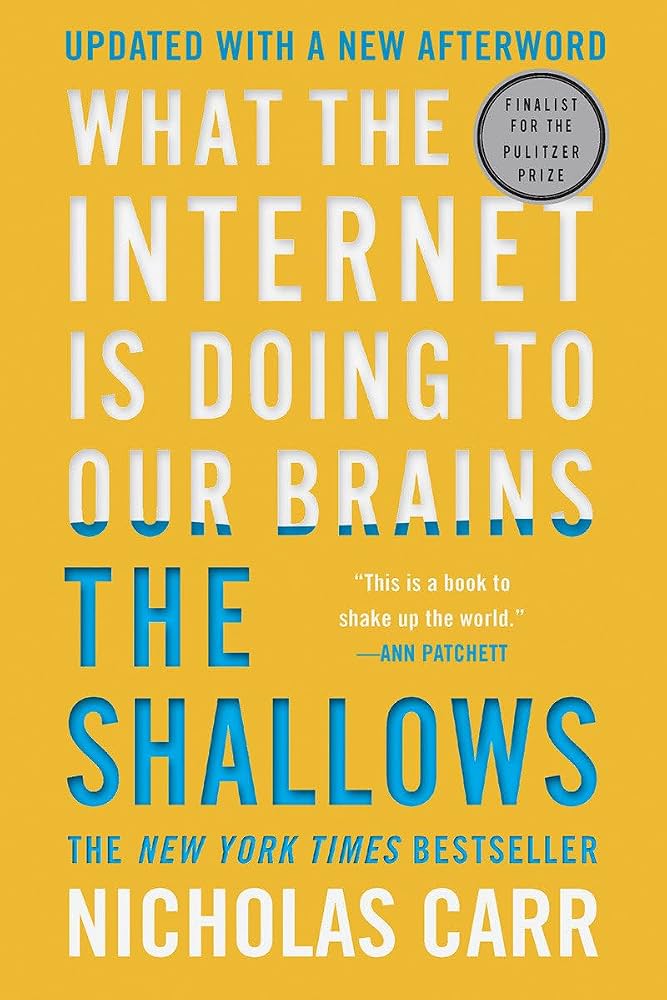
What the Internet is Doing to Our Brains: The Shallows
Nicholas Carr
ISBN: 0393357821
Publisher: W.W. Norton & Company
Year: 2020
|
 |
Book
Supremacy: AI, ChatGPT, and the Race That Will Change the World
Parmy Olson
ISBN: 1250337747
Publisher: St. Martin's Press
Year: 2024
|
You must bring your book to every class.
8.5 x 11" Notebook -
You must have a notebook that is dedicated to this class. You will be writing nearly every week in you notebook and this directly makes up a large component of the grade.
You must bring your notebook to every class.
CSU Email -
I send emails regularly throughout this course. You are required to check your email often.
Canvas -
Canvas always holds the most current and authoritative set of due dates, exam dates, assignment instructions, and other course material. Course announcements will be done via Canvas (which also sends these to your csuchico.edu email address).
The partition of your final grade is made up of the following components:
- Attendance (15%) - You are required to be present in class in order to participate in class discussion, reflections on reading, and peer-editing.
- Reading Assignments (15%) - Questions about the reading will be posed on Canvas and due prior to the start of class.
- Essays (70%) - This category includes in-class writing workshops in your notebook, used to test your reading comprehension and writing ability, as well as final polished versions submitted through Canvas. You may get help from the writing center prior to submitting on Canvas.
Grading Scale
A 93% - 100%
A- 90% - 92.99%
B+ 87% - 89.99%
B 83% - 86.99%
B- 80% - 82.99%
C+ 77% - 79.99%
C 73% - 76.99%
C- 70% - 72.99%
D+ 67% - 69.99%
D 63% - 66.99%
D- 60% - 62.99%
F < 60%
Note: Up to 0.5% may be added to your final grade at the instructor's discretion for constructive participation in the class. Constructive participation includes in-class participation; asking good questions or engaging with disucssions about the book; etc. No other adjustments of borderline grades will be considered.
Time, Effort & Attitude
Writing well is a skill that requires time and effort to develop. It is very important that your skill set includes the ability to express yourself in English in written form in a way that can be easily understood by others. Many of you can already write well. For you, this course will mostly be about applying your writing skills to the topics we read during the course of the semester, demonstrating your writing skills, and hopefully picking up a few ways to hone your writing skills along the way. For others, your writing skills could use some improvement. You will need to demonstrate that you are able to effectively communicate your ideas in written English form by the end of the semester. I will be able to give some general guidance on areas you need to work on for improvement, but you may need to seek outside help to improve your skills to a level needed to pass this course.
Late Policy
An important part of your education and professional development in college is about learning to independently manage work and deadlines. This skill is incredibly authentic and valued by employers. It is a disservice to you if I act like deadlines do not matter. Moreover, new concepts need to be applied quickly to be retained in memory. Therefore, there is a late policy in effect.
Essays written in notebooks must be made-up in my office hours no later than 1 week after the in-class activity. You must email me prior to the essay to schedule a make-up if you will not attend for any serious reason.
Polished essays (submitted on Canvas) can be turned in up to 48 hours late and are subject to a 5% penalty per day, even if turned in minutes after the due date. Exceptions are granted only for specific circumstances such as illness or emergency. Only your most recently submission will be graded (e.g., if you submit an incomplete program before the due date and then submit a complete program after the due date, I will grade the late submission.)
Illness
If you are ill (fever, coughing or contagious with anything), please don't come to school. Stay home. Although in-class writing workshops may not be made up for any reason, one workshop submission may be marked as absent without a loss of points.
Regrade requests will be accepted up to 1 week after a graded item is returned. The reason for the regrade request must be explained in email, with a copy of the assignment to be re-graded, to the instructor's university email. Note that all regrade requests, except for those pointing out mistakes in the totaling of points, will cause the entire assignment to be re-graded. The adjusted grade may therefore be higher or lower than the initial grade.
It is the policy of the Computer Science Department that a grade of Incomplete (I) shall be assigned only when the instructor concludes that a clearly identifiable portion of course requirements cannot be met within the academic term for unforeseen, but fully justified, reasons; and when there is still a possibility of earning credit.
An incomplete shall not be assigned when:
- The request is made before the thirteenth week of instruction.
- It is necessary for the student to attend a major portion of the class when it is next offered (i.e., if a student needs to repeat a class, an incomplete should not be given).
- The student is not passing the course with a D- or better at the time of the request.
- The student is unable to keep up with course work due to an excessive course load.
The student must retain the grades for any coursework that was due prior to the incomplete being assigned. An incomplete grade cannot be removed on the basis of work taken at another institution nor by re-enrolling in the course.
An incomplete must be made up within one calendar year immediately following the end of the term in which it was assigned. This limitation prevails whether or not the student maintains continuous enrollment. Failure to complete the assigned work will result in an incomplete "I" being converted to an "NC" which will affect the grade point average.
You are to work individually in this class.
Your submitted work will be scanned by anti-plagiarism software to ensure that your work was created by you. Your submissions will be compared with the student's from the current and prior semesters, and flagged for AI generated content. You must cite all external sources of material.
Do not use AI services like ChatGPT or Gemini to generate your written content. These services can be helpful for getting general advice on writing skills, or performing background research for a topic, and using them for these purposes is fine, but make sure all of your submitted work is 100% generated by you, and that you quote and cite all external sources. Do not copy / paste from any source without a citation. Use of AI:
- You are to generate your own writing.
- You may use digital assistants, like spelling and grammar checkers.
- You may get help from tutors.
- You may use the edu version of ChatGPT to get feedback and suggestions for improvement on your drafts prior to submission.
- Do not prompt AI to rewrite any part of your writing assignments.
- Do not submit any writing as your own that you did not write.
- Don't copy from any source without citation, including AI generated content.
If you become involved in any incident of academic dishonesty, the first offense is a zero on that assignment and possibly a referral to the department chair. The second offense of academic dishonesty will result in an F in this course and a referral to the Student Conduct, Rights and Responsibilities office.
Enough said... I don't want to police you, I want to teach you, so please help me out by being honest and using common sense.
Disability Services for Students
If you are a student with a disability, and think you may need academic accommodations, please contact Accessibility Resource Center (ARC, see link) as early as possible in order to avoid a delay in receiving accommodation services. Use of ARC services, including testing accommodations, requires prior authorization by ARC in compliance with university policies and procedures.
Athletic Schedules
To student athletes: I value your identity as a scholar/athlete. Please notify me before the end of the drop/add period about any possible game conflicts with our class schedule (and as soon as possible about subsequent changes).
AWK: Awkward wording.
ARTERR: Missing article(s), or misuse of articles (the, a, an...).
CONJERR: Conjugation error.
CAPERR: Capitalization error
INCOMP: Incomplete: You need not completely address all of the assigned topics.
INCON: Incomplete conclusion
INCS: Incomplete sentence
LONGS: One or more overly long / complex sentences.
LONGP: One or more overly long paragraphs.
MICIT: Missing or incomplete citations (every reference / quotation need a citation that ties in with a bibliography at the bottom).
MIXPOV: Unneeded shifts in point-of-view / person (1st/2nd/3rd).
MIXTENS: Unnecessary shifts in tenses (past/present/future)
PUNCT: Issues with punctuation.
POSS: Issue with possessive form.
PVOICE: Avoid passive voice.
SINGPLUR: Singular / plural disagreement
SUPPORT: Support needed
TENSE: Tense disagreement;
THESIS? : Missing thesis statement in first paragraph.
TYPO: Typographical error
TYPOS: Proofread prior to submission to catch minor typographical errors.
REP: Repeated or redundant content.
PTOP: Paragraph missing topic sentence.
PUNI: Paragraph not unified on a central topic.
UCOMM: Use commas to separate the clauses within sentences.
VAGBR: Vague back reference: A word that referred back to another word or concept previously mentioned, that was unclear.
VERBOSE: One or more sections are overly wordy.
WORDC: Word Choice Error: Incorrect use of language or mismatch of word usage and definition.